





News
Contact us and someone will be in touch with you shortly.
Recent News
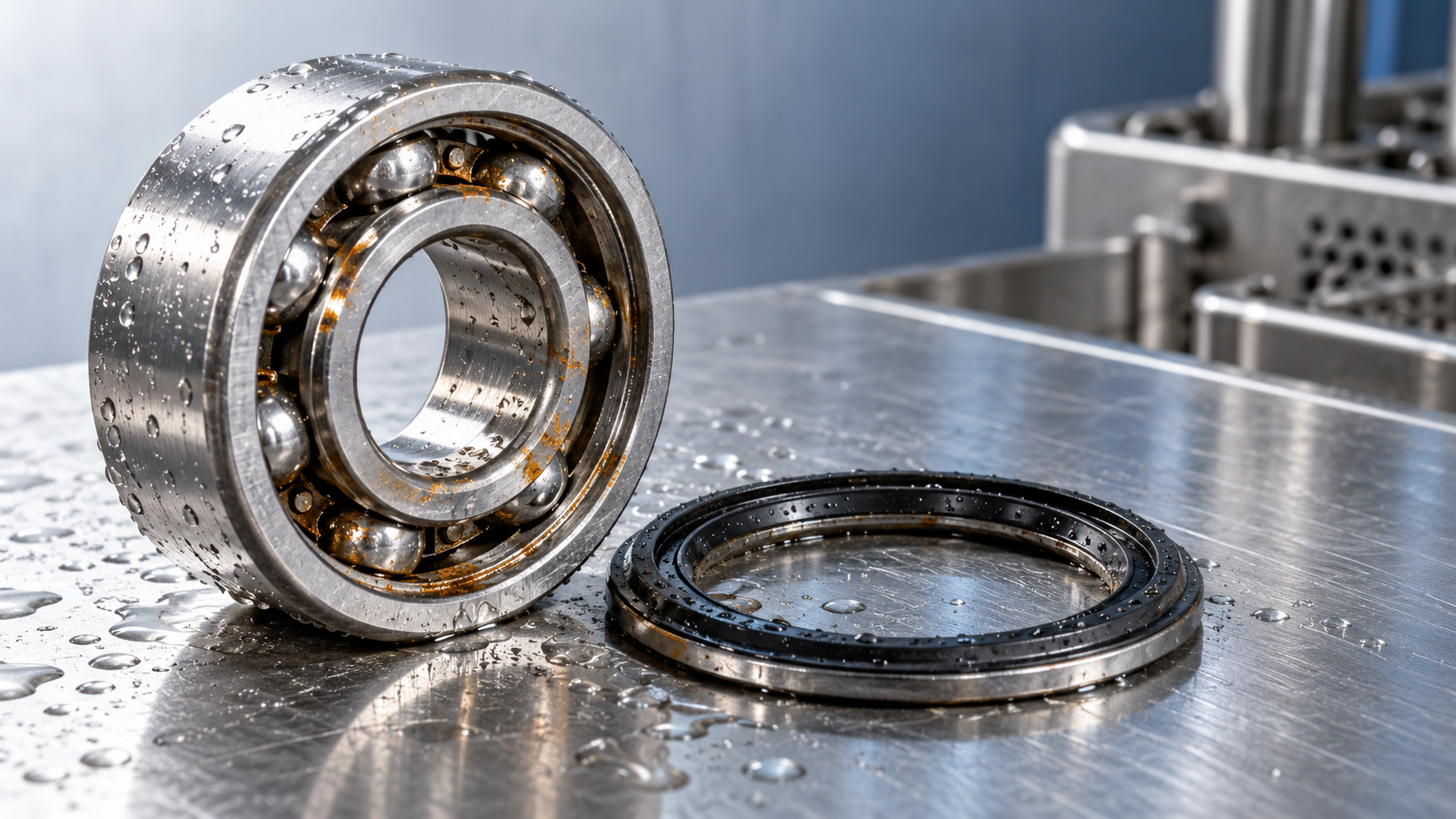
Stainless steel bearings can rust in washdown equipment because their corrosion resistance has limits. Chloride residues, unsuitable cleaning chemicals, trapped water, and contamination from ordinary steel can damage the thin protective film on the metal. Once water reaches the rolling surfaces, corrosion can develop even when the outside of the bearing looks relatively clean.
Replacing the bearing with another “stainless” version may repeat the failure if the material, seals, lubricant, and cleaning conditions remain unchanged. The useful starting point is to establish where the rust begins, how liquid reaches that location, and which components are actually stainless steel.
“Stainless” does not describe one level of corrosion resistance
Stainless steel protects itself through a thin, chromium-rich oxide film. Under suitable conditions, this film can reform after minor surface damage. Chlorides and aggressive chemical exposure can disrupt that protection, particularly in crevices where liquid remains trapped and oxygen availability is restricted.
Bearing materials also have to withstand repeated rolling contact. Common hardened stainless bearing steels, including 440C, provide the hardness needed for raceways and balls, but their corrosion resistance differs from that of austenitic stainless steels such as 304 or 316. A stainless housing and a stainless bearing insert may therefore respond differently to the same cleaning solution.
Choosing 316 for an external component does not automatically make it a suitable replacement material for a hardened raceway. Load capacity, hardness, speed, and bearing construction still matter. Material selection must address both corrosion exposure and mechanical duty.
Check the complete assembly: rings, balls, cage, shields, seal reinforcement, locking collar, fasteners, shaft, and housing. A stainless housing can contain an insert with different corrosion resistance, while an ordinary steel fastener can produce rust streaks across otherwise sound stainless surfaces.
Read the rust pattern before cleaning away the evidence
Photograph the assembly before dismantling or removing deposits. Record which side faces the washdown nozzle, where water collects, and whether the rust appears outside the seal or inside the bearing. These observations help distinguish surface contamination from liquid ingress and raceway damage.
Color alone cannot establish the cause. Fine orange staining can come from embedded iron particles, while serious pitting may initially occupy only a small area. Inspect cleaned surfaces for cavities, roughness, and damage to the rolling track. A bearing that turns freely by hand can still have damage that becomes noisy under load.
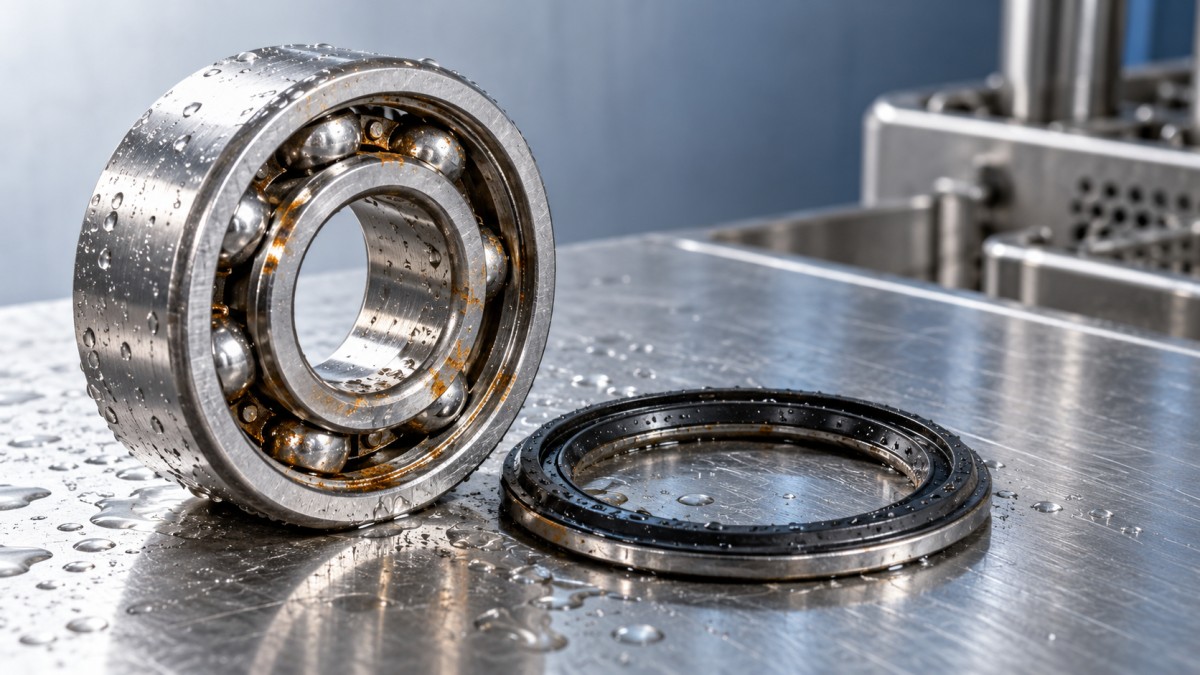
If rust or pitting is present on a raceway or rolling element, cleaning the visible deposit does not restore the original surface. Replacement is generally appropriate once rolling-contact surfaces are damaged. External staining may be treatable if the underlying surface remains intact and treatment can be carried out without contaminating the bearing.
Cleaning conditions can overwhelm a suitable bearing
Chlorides may come from process ingredients, salt deposits, rinse water, or chlorine-containing cleaners. They can encourage localized attack, especially where residues concentrate as water evaporates. A bearing that tolerates brief exposure followed by effective rinsing may deteriorate when the same solution sits beneath a seal overnight.
Cleaning chemical names alone are insufficient for judging compatibility. Concentration, temperature, contact time, and rinsing all influence the result. A cleaner used too strongly or left in a pocket can expose the bearing to conditions quite different from the intended cleaning procedure.
Review what actually happens at the machine. Check dilution equipment, nozzle direction, application time, and rinse coverage. Look for areas that remain wet after surrounding surfaces dry. Recurring corrosion at one bearing position often points toward local exposure or poor drainage rather than a problem affecting every bearing equally.
Hot washing followed by cooling can also contribute to moisture entry. Temperature changes can create pressure differences in enclosed spaces, and moist air can condense as components cool. Standing water around a seal makes these conditions less forgiving.
Do not reduce necessary sanitation to protect a bearing. Coordinate changes with the people responsible for cleaning effectiveness. Equipment protection should come from compatible materials, suitable cleaning parameters, controlled spray direction, and hygienic drainage.
A sealed bearing is not automatically protected against washdown jets
Integral bearing seals mainly retain grease and limit contaminant entry under their intended operating conditions. They should not be assumed to withstand a direct high-pressure jet. Water can pass a seal lip, enter along the shaft, or collect behind an end cover even when no obvious seal tear is visible.
Where possible, direct spray away from seal lips and shaft openings while maintaining required cleaning coverage. Shields, deflectors, and suitable external seals can reduce direct exposure, but their design must avoid creating inaccessible pockets that retain product residue or cleaning solution.
Inspect the surface on which the seal runs. Grooves, corrosion, poor finish, shaft movement, or misalignment can prevent a sound seal from maintaining contact. Replacing only the seal leaves the entry path in place if the shaft or mounting arrangement is damaged.
More sealing is not automatically better. Additional contact seals can increase friction and heat, and an unsuitable enclosure can trap moisture. Select the sealing arrangement around shaft speed, temperature, available space, cleaning exposure, and the ability to drain.
Inspect housing orientation and drainage features as well. A blocked drain, upward-facing recess, or tightly enclosed wet pocket can keep liquid against the bearing long after washing ends. Correct drainage problems without drilling or modifying housings in ways that compromise strength or hygienic design.
Grease helps, but increasing the quantity may not solve corrosion
Grease provides a lubricating film and can help protect surfaces from moisture. Its performance depends on water resistance, corrosion protection, mechanical stability, temperature capability, and compatibility with the bearing and seals. A lubricant suitable for incidental food contact still needs the performance characteristics required by the application.
Water washout and water spray resistance describe different aspects of exposure. Resistance to water mixing into the grease also matters. Select lubricant using the actual washdown conditions and bearing duty, rather than treating one property as proof of suitability.
Inspect discharged grease for cloudiness, free water, unusual thinning, hardening, and rust-colored debris. These signs support an ingress investigation, although grease appearance alone cannot identify the entry point. Where failures recur, lubricant analysis can help distinguish water contamination from other deterioration.
Adding more grease can temporarily displace contamination in an assembly designed for controlled purging. It can also cause churning, heat, or seal displacement if the quantity or pressure is excessive. Some sealed bearings are not intended for relubrication at all.
Use the specified grease quantity and method. When changing lubricant, establish compatibility and an appropriate changeover procedure; mixing greases can alter consistency and performance. Keep grease fittings clean before connecting the gun, and protect stored lubricant from washdown water.
Choose the replacement around the failure mechanism
A useful replacement specification describes both the running conditions and the cleaning conditions. Record load, speed, operating temperature, shaft arrangement, cleaning chemistry, dilution, wash temperature, spray exposure, and shutdown duration. Include photographs of the corrosion and the removed seal condition.
Then match the corrective action to the evidence:
- External iron contamination: remove the contamination source, separate tools used on ordinary steel from those used on stainless surfaces, and use an appropriate surface-cleaning process.
- Internal water ingress: address seal selection, shaft condition, direct spray exposure, and drainage before fitting the replacement.
- Pitting despite controlled ingress: review material resistance against the actual chemical environment and consider a more corrosion-resistant bearing construction.
- Persistent wet shutdowns: improve drainage and drying arrangements and review suitable lubrication or preservation measures for idle periods.
Alternative stainless grades, specialized corrosion-resistant steels, coatings, ceramic components, and polymer bearing arrangements each have application limits. They are not interchangeable upgrades. A polymer arrangement that works well on a lightly loaded conveyor may be unsuitable for a heavily loaded, high-speed shaft. Ceramic balls do not protect steel rings from corrosion.
Coatings also need careful selection. Protection depends on coverage, adhesion, chemical compatibility, and resistance to damage during installation and operation. Exposed edges or damaged areas can remain vulnerable. Evaluate the complete bearing assembly rather than one corrosion-resistant feature.
When discussing a catalog item such as 32036X2AT150/DBC150, use the designation to identify the component being reviewed. Washdown suitability requires separate assessment of its materials, sealing, lubrication, and operating limits; the product name alone does not establish those properties.
Make the next service visit produce a clear decision
Before removal, isolate the equipment under the applicable maintenance procedure. Preserve the bearing, seals, and a representative grease sample where practical. Cleaning everything immediately can erase the evidence needed to explain a repeat failure.
- Map the damage. Distinguish rust on surrounding hardware, staining on exposed bearing surfaces, and corrosion inside the rolling contact area.
- Trace the moisture route. Inspect nozzle direction, seal lips, shaft tracks, covers, housing pockets, and drains.
- Review chemical exposure. Compare actual dilution, temperature, contact time, and rinsing with the intended cleaning procedure.
- Check the assembly specification. Identify the materials and lubricant used in the bearing, housing, seals, and adjacent components.
- Document the correction. Record the replacement specification and changes to washing, sealing, drainage, or lubrication so the next inspection has a meaningful comparison.
Check the corrected position after washdown and again after a representative shutdown. Look for retained water, fresh staining, grease leakage, abnormal noise, and changes in running temperature. Early inspection can reveal a remaining entry path before another bearing develops extensive damage.
The most useful question before installing another bearing is: what allowed moisture or chemicals to remain in contact with a vulnerable surface? Once that is established, material selection and maintenance changes can address the cause of the rust rather than simply reset the replacement cycle.


Huamai Power
Thank you very much for writing to us. Please leave your message and contact information, we will reply to you within 24 hours.