





News
Contact us and someone will be in touch with you shortly.
Recent News
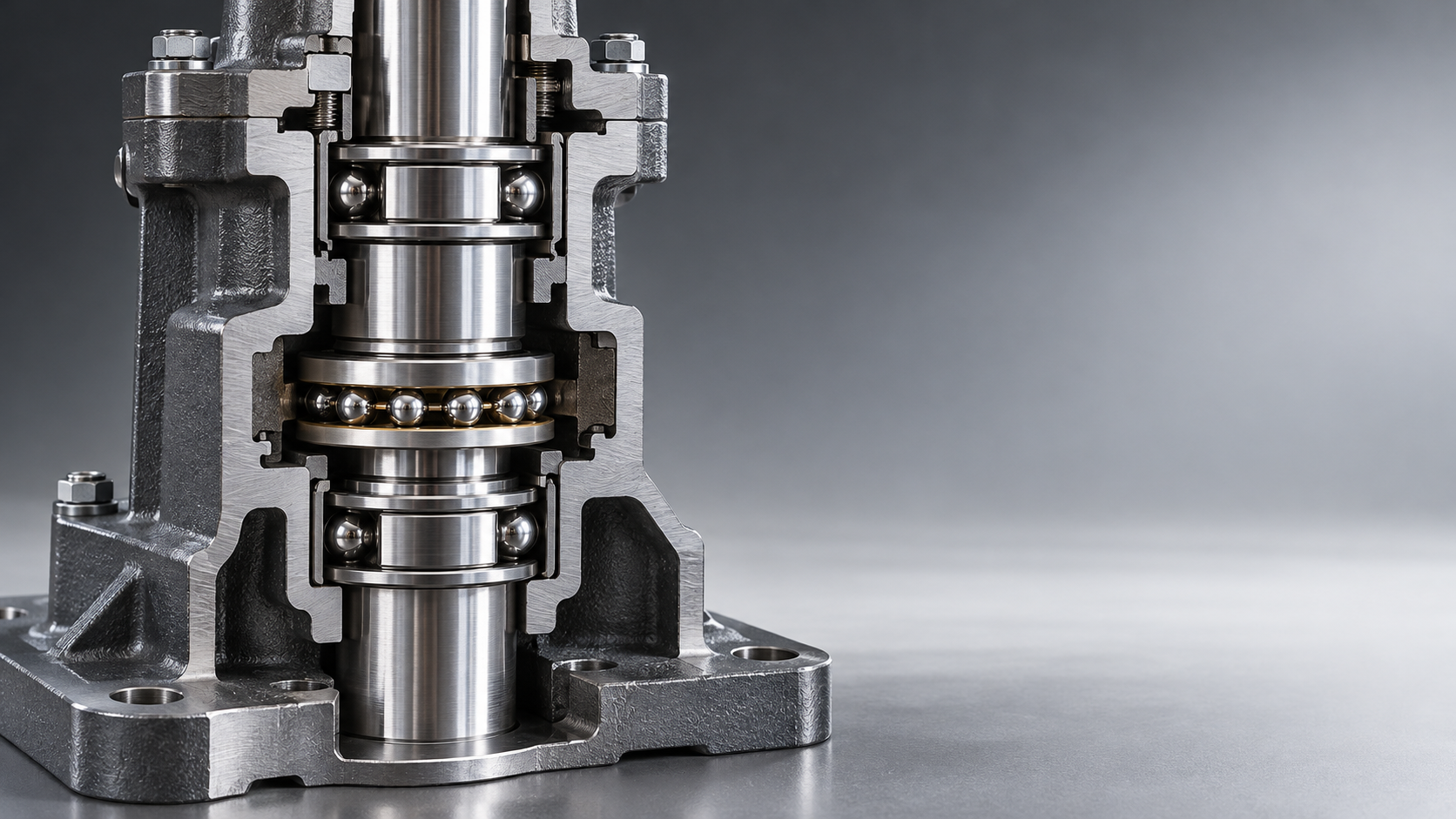
Can thrust ball bearings support radial loads in vertical shafts?
No. Standard thrust ball bearings are designed to carry axial loads, not radial loads. Installing one on a vertical shaft does not change that limitation. It may support the weight of the shaft and attached components, but sideways forces still need a separate radial bearing or a bearing arrangement designed for combined loading.
The distinction matters because a vertical shaft can look like a straightforward thrust-bearing application while carrying significant lateral forces. A belt-driven vertical mixer is a good example: gravity acts downward along the shaft, while belt tension pulls across it. Both loads exist at the same time, but they need different load paths through the bearing assembly.
The useful question is therefore not simply whether a thrust bearing can hold up the shaft. It is whether the complete support arrangement can carry every operating force without asking one bearing to do a job its geometry does not allow.
Vertical describes orientation, not the complete load condition
Axial force acts parallel to the shaft centerline. Radial force acts perpendicular to it. On a vertical shaft, the weight of a centered rotor usually contributes an axial load. However, shaft orientation says very little about belt forces, gear reactions, hydraulic forces, coupling reactions, or rotor imbalance.
Consider a vertical pump. The rotating assembly has weight, but the impeller can also generate hydraulic thrust, and radial forces may arise under particular operating conditions. Depending on the pump design and operating point, the net axial force may increase, decrease, or reverse. Selecting a bearing only from the assembly weight would miss much of the actual duty.
An overhung pulley adds another complication. Its lateral force creates a bending moment as well as bearing reactions. The distance between the pulley and the nearest support, together with bearing spacing, affects those reactions. A modest external side force does not necessarily mean a modest load at each bearing.
Before choosing bearings, sketch the shaft, support locations, and applied forces. Include startup, shutdown, and abnormal but foreseeable conditions. That simple exercise often reveals why a thrust-only solution is incomplete.
Why thrust ball bearings cannot double as radial guides
A conventional single-direction thrust ball bearing consists of a shaft washer, a housing washer, and a ball-and-cage assembly between them. Its raceways are arranged to transmit force axially from one washer, through the balls, to the other washer.
That arrangement is fundamentally different from a radial ball bearing, whose raceways support radial loading around the shaft. A thrust bearing's cage spaces and guides the balls; it is not a substitute for a radial shaft support. Nor should contact between a washer bore and a nearby component be treated as an acceptable lateral load path.
If a thrust bearing is forced to restrain sideways movement, the assembly can experience displaced contact, rubbing, uneven loading, and cage distress. Exactly what fails first depends on the fits, clearances, speed, and surrounding structure. The absence of immediate failure does not make the arrangement suitable.
There is no general “small allowable radial load” percentage for standard thrust ball bearings. Do not take a fraction of the axial load rating and use it as a radial allowance. Unless the specific manufacturer's documentation explicitly permits a different duty, treat radial load capacity as unavailable for design purposes.
A spherical seating washer does not change this rule. In suitable designs, it can accommodate some initial seating misalignment. It does not turn a thrust ball bearing into a combined-load bearing or a guide for substantial shaft deflection.
A workable vertical-shaft arrangement separates the load paths
Where loads and speeds suit the application, a separate thrust bearing can carry the axial force while radial bearings guide the shaft. The thrust bearing then has a clearly defined purpose: transferring shaft thrust into a housing shoulder or other properly designed support.
The radial bearings control lateral position and carry reactions from external forces and bending moments. Their number and spacing depend on shaft stiffness, overhung components, alignment requirements, and operating speed. One radial bearing placed beside a thrust bearing is not automatically a complete solution for a long shaft.
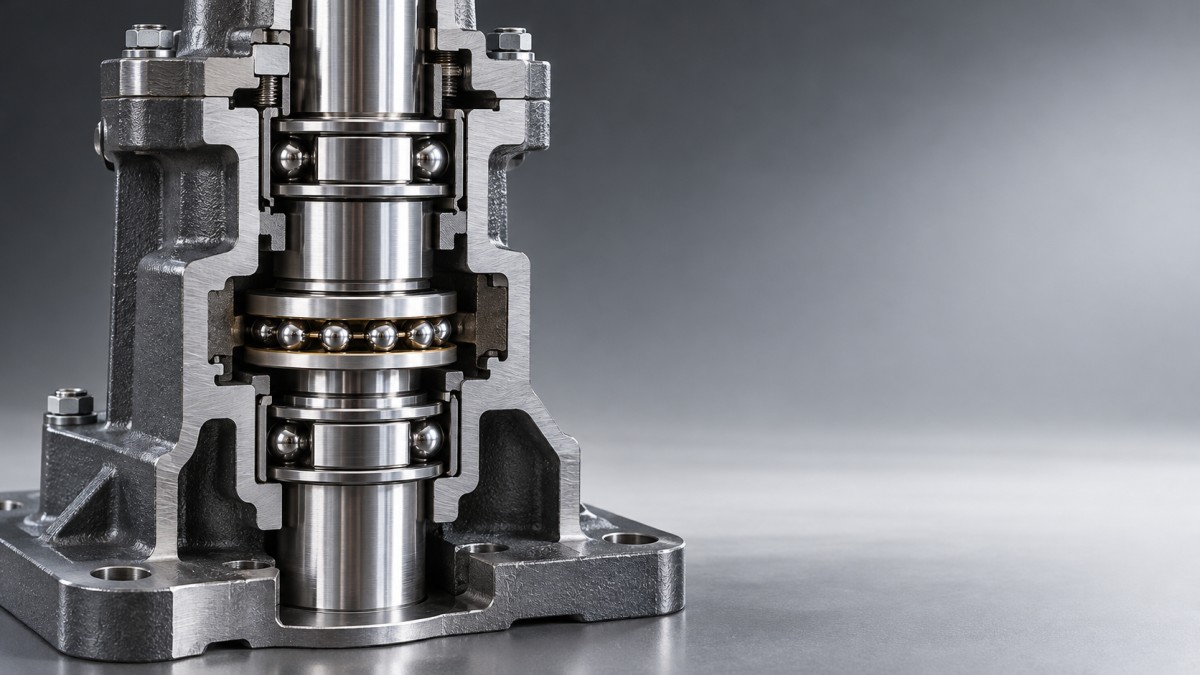
The less obvious task is controlling axial location. If multiple bearings are unintentionally clamped so that each tries to locate the shaft axially, thermal expansion can create internal loads that were never included in the calculation. The design must define which bearing arrangement locates the shaft and where the necessary expansion or displacement is accommodated.
This deserves attention when deep groove ball bearings provide radial guidance because they can also carry axial load. Without deliberate shoulder, fit, and clearance choices, they may pick up thrust intended for the separate thrust bearing. Load sharing should be engineered, not left to assembly tolerances.
What if thrust changes direction?
A single-direction thrust ball bearing carries axial load in one direction only. Gravity may keep it loaded during normal operation, but an upward process force can reduce that load or lift the rotating assembly away from its intended support.
A double-direction thrust ball bearing can accommodate axial loading in either direction, but it still does not provide radial capacity. Reversing thrust therefore changes the axial-support requirement, not the need for radial guidance. Endplay, minimum load, and any preload provisions must be checked against the selected bearing's instructions.
When combined-load bearings make more sense
Separating radial and axial support is useful, but it is not always the simplest or stiffest arrangement. When both loads are substantial, an angular contact ball bearing arrangement or tapered roller bearing arrangement may provide a more direct solution.
Angular contact ball bearings carry combined radial and axial loads. Their contact angle, arrangement, and preload influence thrust capacity, stiffness, and speed suitability. A single bearing generally supports axial load in one direction; an appropriately configured pair can handle reversing thrust and provide moment resistance.
Tapered roller bearings also accommodate combined loads and may suit applications needing substantial load capacity and stiffness. They require careful adjustment and lubrication, however, and should not be treated as a universal replacement for a high-speed ball-bearing arrangement.
Deep groove ball bearings can be sufficient where radial load dominates and axial load remains within the specific bearing's limits. The catalog entry 6317-2Z/P6CMV2 is one product reference to investigate during selection, rather than a recommendation for every vertical shaft. Confirm its load ratings, speed limits, internal clearance, lubrication provisions, and suitability for the actual mounting arrangement before specifying it.
The choice should follow the load case. Replacing a thrust bearing with a larger thrust bearing does not solve a radial-support problem.
Checks that matter beyond the load rating
Even when radial loads are handled elsewhere, a vertical thrust-bearing installation needs more than sufficient catalog capacity. Several practical details can determine whether the arrangement runs reliably:
- Minimum axial load: Thrust ball bearings generally need sufficient axial loading to maintain proper rolling contact. Shaft weight alone may not meet the manufacturer's requirement at the intended speed, particularly if process forces partially cancel it.
- Washer support and alignment: Supporting faces need suitable stiffness, flatness, and squareness. A distorted support can produce uneven loading even when the nominal thrust is acceptable.
- Lubricant delivery: In vertical assemblies, lubricant distribution and drainage deserve explicit attention. Confirm that the selected grease or oil system reaches the contacts without causing excessive churning.
- Speed and temperature: Check limits for the actual bearing, cage, lubricant, and cooling conditions. A satisfactory static load check does not establish high-speed suitability.
- Assembly and retention: Follow the drawing and mounting instructions for washer orientation, fits, shoulders, and shaft retention, including what happens when the thrust bearing becomes unloaded.
If an existing machine shows heat, noise, or repeated cage damage, avoid assuming that a higher axial capacity will fix it. Check for unintended radial restraint, shaft deflection, inadequate minimum load, and lubrication problems before changing the bearing size. Damage patterns need to be considered alongside the operating history.
What to establish before selecting the bearing
A useful selection brief includes shaft orientation and speed, axial loads in both directions, radial forces and their locations, bearing spacing, duty cycle, temperature, lubrication method, and available mounting space. Include a shaft-and-housing drawing where possible. “Vertical shaft, heavy rotor” is not enough information to determine a reliable arrangement.
Shandong Huamai Power Technology Co., Ltd., based in Linqing, Liaocheng, Shandong Province, manufactures thrust, deep groove, angular contact, and roller bearings, alongside customized non-standard designs. That product range allows the selection discussion to consider separate or combined-load support rather than starting with one bearing type. Custom dimensions may resolve a packaging constraint, but they do not remove the need to establish the correct load path.
For any vertical shaft, the decisive check is straightforward: identify the component that carries each radial force. If the answer is the thrust ball bearing, its cage, or incidental contact with a washer, the support arrangement needs revision before bearing life calculations can be meaningful.


Huamai Power
Thank you very much for writing to us. Please leave your message and contact information, we will reply to you within 24 hours.