





News
Contact us and someone will be in touch with you shortly.
Recent News
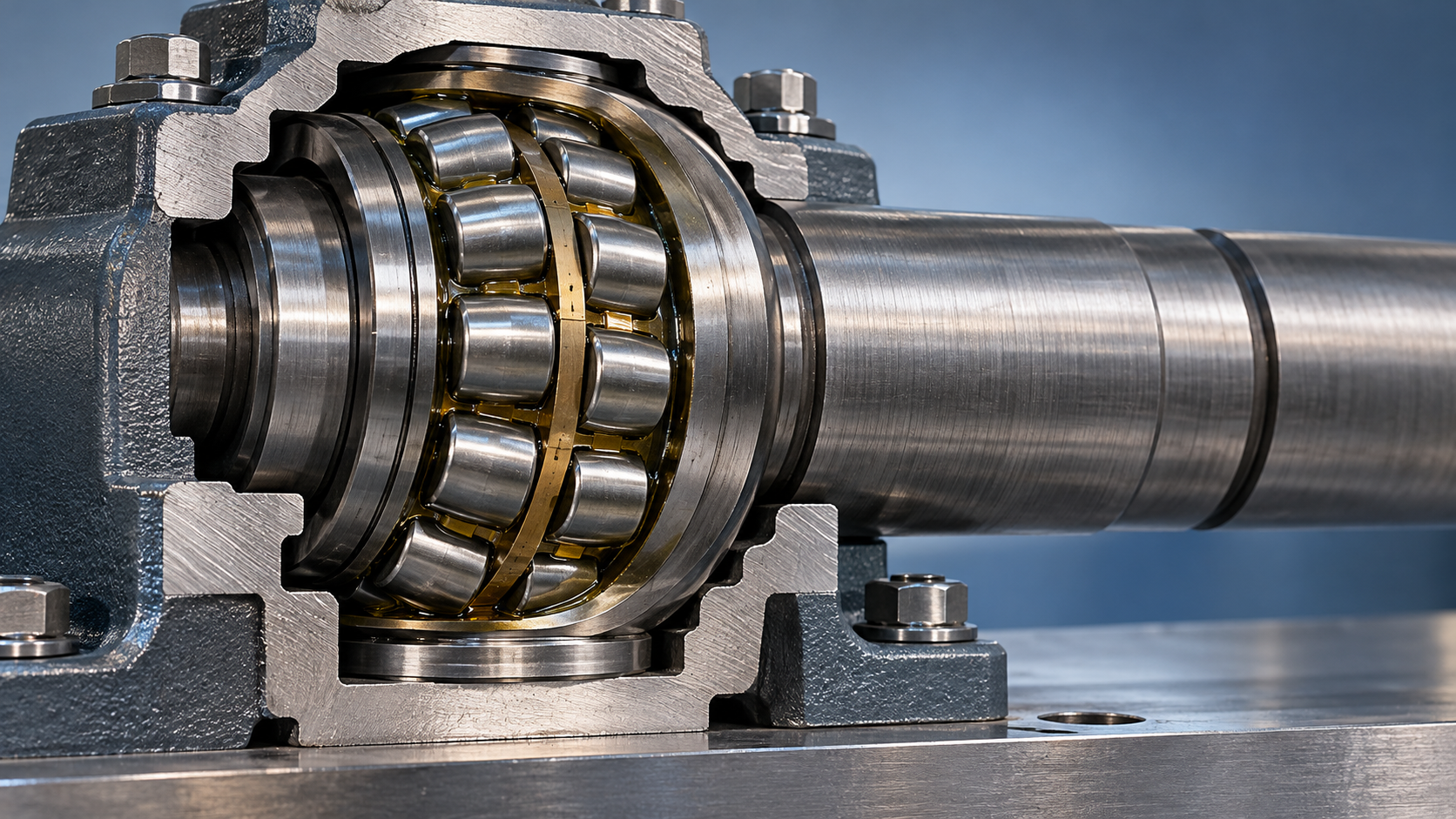
How minimum load requirements prevent skidding in spherical roller bearings
Spherical roller bearings can experience damaging skidding when operating loads are too low to maintain adequate traction between rollers and raceways. Minimum load requirements are therefore a selection criterion, not simply a catalog detail. Meeting them helps rollers maintain the intended rolling motion, reducing the risk of frictional heating, smearing, and premature surface damage.
The difficulty is that a bearing may be adequately loaded during production but lightly loaded during commissioning, empty running, or rapid acceleration. A satisfactory fatigue-life calculation does not automatically make those conditions acceptable. The technical review must connect the manufacturer’s minimum load guidance with the machine’s actual duty cycle, lubrication, and bearing arrangement.
Why a lightly loaded roller can slide instead of roll
A roller does not rotate at the appropriate speed merely because the shaft is turning. Traction at its contacts with the raceways must drive its rotation against resistance from lubricant, cage interaction, and other dynamic effects. When contact load is insufficient, that traction may not keep the roller moving at the speed required by the bearing’s kinematics.
Some sliding is inherent in rolling-bearing contacts; the objective is not to eliminate every difference in surface velocity. The concern is excessive slip that generates damaging heat or disrupts surface separation. In spherical roller bearings, rollers passing through a lightly loaded zone can lose rotational speed and then accelerate as they enter the loaded zone. Unfavorable conditions at that transition can contribute to smearing.
The manufacturer’s minimum load recommendation establishes a lower operating boundary intended to support reliable rolling under specified conditions. It is not a guarantee against damage from contamination, incorrect clearance, poor lubrication, or mounting errors.
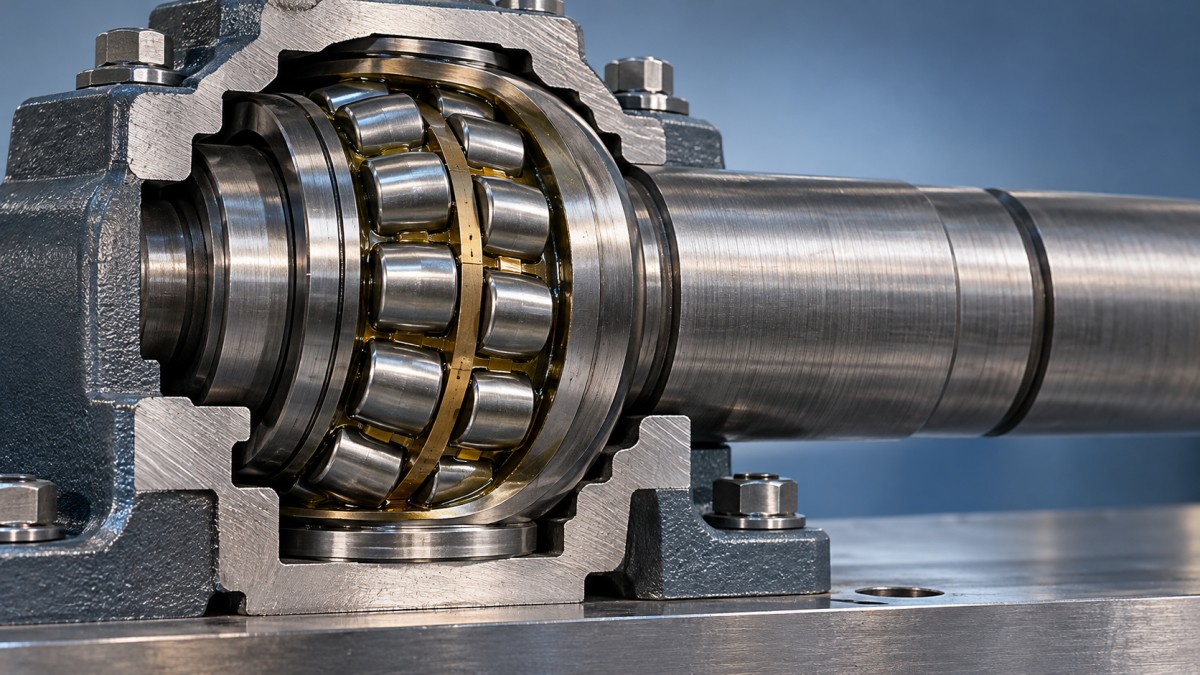
Minimum load is a separate check from load capacity
Bearing selection commonly starts with dynamic load rating, static load rating, and calculated life. Those checks address different questions from minimum load. A bearing selected to withstand heavy process loads may still be too lightly loaded when the equipment runs empty.
Oversizing can make this conflict worse. Increasing bearing capacity may improve a calculated fatigue-life result while also changing the minimum load requirement, friction, and speed capability. “More capacity” is not automatically “more suitable,” particularly where unloaded operation is frequent.
ISO 281 addresses dynamic load ratings and rating life, while ISO 76 addresses static load ratings. Neither replaces the bearing manufacturer’s application-specific minimum load guidance. A review based only on rating life leaves an important operating limit unresolved.
Avoid applying a universal percentage of load rating to every spherical roller bearing. Manufacturers may specify a minimum radial load, an equivalent load criterion, or an expression involving speed, lubricant viscosity, and bearing-specific factors. Use the method stated for the selected design, and keep its load definitions and units intact.
Speed and lubrication change the operating margin
Minimum load cannot be judged from shaft weight alone. At higher speeds, dynamic effects and lubricant resistance can make lightly loaded operation more demanding. Rapid speed changes also matter because the rollers and cage must accelerate, not simply maintain steady motion.
Lubrication creates a necessary trade-off. The contact needs an adequate lubricant film, but a more viscous lubricant can increase resistance to roller motion. This is especially relevant during cold starts, when viscosity may be substantially higher than at stabilized operating temperature. A machine that runs satisfactorily when warm may have a less favorable traction balance during startup.
Excess grease or an unsuitable oil level can also increase churning and heat generation. However, reducing lubricant quantity or viscosity without checking film adequacy is not a sound remedy. That can exchange a skidding concern for inadequate lubrication.
Evaluate lubricant viscosity at the relevant temperatures, the delivery method, grease fill or oil level, and the speed profile together. Where supplier guidance distinguishes cold-start conditions from normal operation, both checks belong in the approval record.
Find the lowest bearing load—not the average machine load
The critical input is the load reaching each bearing during each operating state. Total equipment weight is not enough. Shaft geometry, coupling forces, belt tension, process forces, and the locating arrangement determine how loads are distributed between supports.
For example, an empty conveyor or unloaded processing machine may retain shaft and pulley weight but lose much of its process-related bearing load. In a two-bearing arrangement, one support can be lightly loaded even when the total assembly load appears substantial. Changes in force direction may further alter the reactions.
- Starting and acceleration: establish the available load while speed and lubricant condition are changing.
- Empty running: calculate reactions without assuming that production loads remain present.
- Normal production: check the full load range, including intermittent low-load periods.
- Coasting and shutdown: consider whether process load disappears before rotational speed falls.
- Testing and commissioning: assess no-load trials separately from the intended production duty.
Do not use an averaged equivalent load from a fatigue calculation as proof that minimum load is always satisfied. Averaging can conceal a lightly loaded operating interval. Nor should a brief interval automatically be treated as harmless: its acceptability depends on speed, lubrication, repetition, and the manufacturer’s assessment.
What to verify for the exact bearing design
A designation identifies a bearing family and configuration, but it does not provide every application limit. Internal design, cage construction, clearance, lubrication provisions, and supplier-specific execution can affect suitability. Do not assume that similarly designated products from different manufacturers have interchangeable minimum load instructions.
For a candidate such as 23284 CA/W33, obtain the manufacturer’s current technical documentation before approving lightly loaded service. Confirm the minimum load method, relevant speed limits, clearance selection, and lubrication requirements for the supplied execution. The designation alone should not be used to infer an acceptable no-load operating speed.
Operating clearance deserves a separate review. Fits and temperature differences change clearance after installation. Excessive clearance can alter load distribution, but deliberately reducing clearance is not a general-purpose cure for skidding. Too little operating clearance introduces other risks, including excessive heat and unintended internal loading.
Likewise, an axial force should not be assumed to solve an insufficient radial load condition. Whether it helps the relevant contacts depends on bearing geometry and the load arrangement. Any proposed preload or external loading scheme needs manufacturer review, including its effects on both roller rows and the complete bearing system.
Choose a remedy that does not create another failure mode
When the calculated operating load falls below the recommended minimum, the answer is not necessarily a different lubricant or a larger bearing. Start with the condition causing the shortfall.
Adjust the operating sequence where possible. Reducing speed during empty running or avoiding prolonged high-speed no-load tests may improve the operating margin. A controlled acceleration profile may also be appropriate, but its limits should be agreed rather than guessed.
Revisit bearing size and arrangement. A smaller bearing may be better matched to the normal load, provided fatigue life, static safety, shaft stiffness, fits, and speed requirements remain acceptable. A different bearing type may deserve consideration if the machine does not actually need the spherical roller design’s load capacity and misalignment accommodation.
Apply additional load only through an engineered arrangement. A controlled external load can sometimes help, but it also increases friction, affects life, and changes shaft and housing reactions. Thermal growth and maintenance conditions must be considered. Arbitrarily tightening fits or imposing preload is not an acceptable substitute.
Shandong Huamai Power Technology Co., Ltd., based in Linqing, Shandong, manufactures standard bearings and develops non-standard designs. For this issue, the useful supplier discussion is a comparison of the actual duty cycle against available bearing configurations—not simply a request for greater capacity. Its design, manufacturing, and technical-service capabilities can support that evaluation, including whether a standard bearing remains appropriate or a customized solution needs investigation.
Close the review with evidence from the machine
Before release, document the calculated reactions, operating speeds, lubricant conditions, and minimum load criterion for every relevant operating state. Where a condition falls outside published guidance, obtain an application-specific assessment rather than treating missing information as approval.
Commissioning should then verify that the machine follows the assessed envelope. Temperature, vibration, noise, and lubricant condition can reveal problems, but none proves by itself that skidding is absent. Smearing found during inspection also needs careful diagnosis because inadequate lubrication and other operating problems can produce related surface damage. ISO 15243 provides terminology for classifying bearing damage; it does not replace a root-cause investigation.
The practical acceptance question is specific: does each bearing receive sufficient load at the speed, temperature, and lubrication condition it actually experiences? If that cannot be demonstrated, revise the operating limits or bearing arrangement before relying on a favorable life calculation.


Huamai Power
Thank you very much for writing to us. Please leave your message and contact information, we will reply to you within 24 hours.