





News
Contact us and someone will be in touch with you shortly.
Recent News
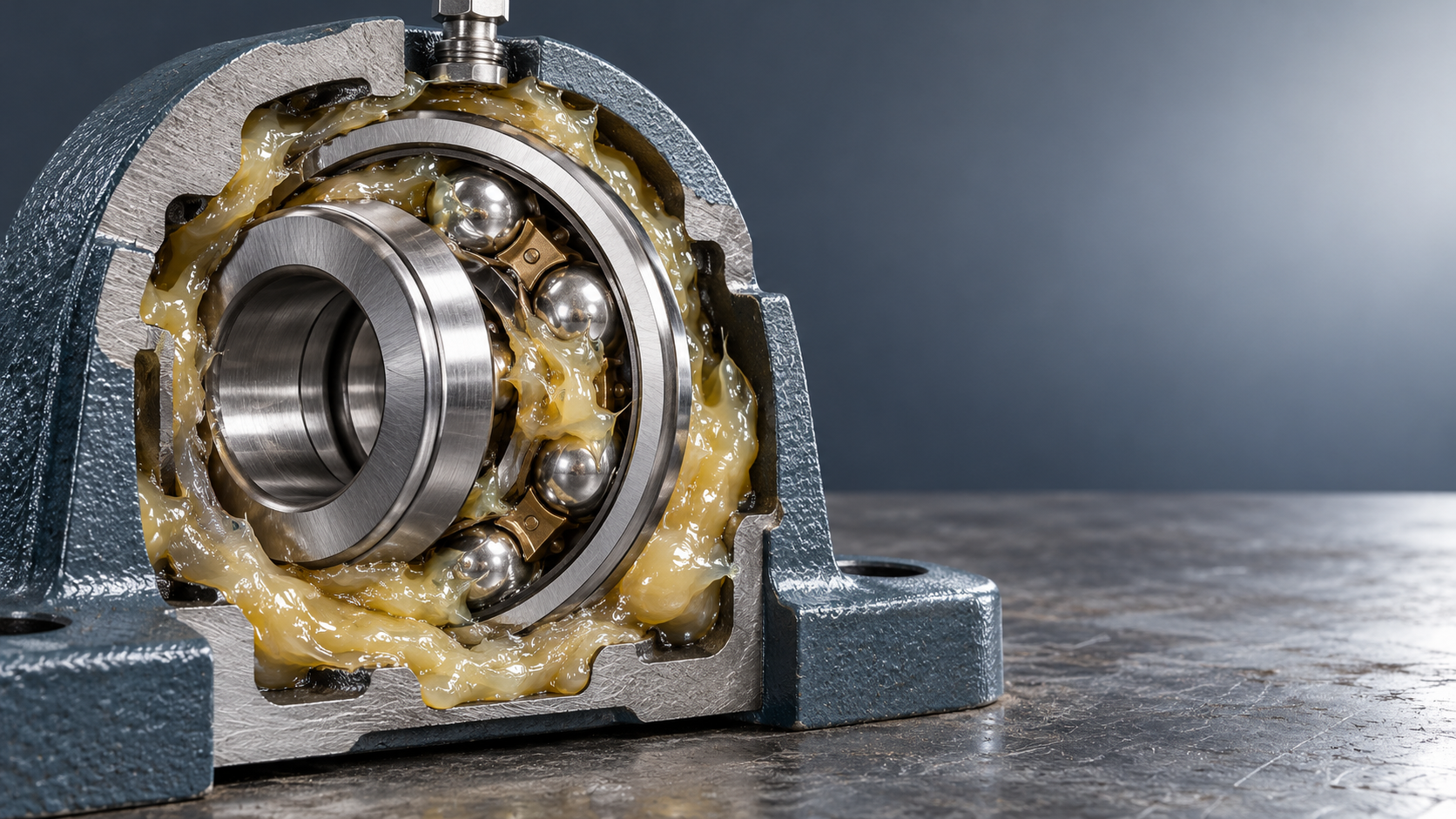
A bearing was running normally before the grease gun came out. Now the housing is hotter, and the maintenance team faces an uncomfortable question: is this a temporary rise, or the beginning of a failure?
Deep groove ball bearings most often overheat after relubrication because excess grease creates churning resistance. Other possibilities include an unsuitable or incompatible lubricant, a blocked grease outlet, contamination introduced during servicing, or an existing mechanical problem that becomes more noticeable afterward. Adding more grease without checking these possibilities can make the situation worse.
The practical task is to establish whether the temperature is stabilizing, identify what changed during servicing, and correct the cause without creating another problem.
Read the temperature trend before reaching for the grease gun
Fresh grease must redistribute around the rolling elements and housing. During this process, resistance can increase temporarily, particularly at higher speeds. A modest temperature rise that levels off and returns toward the established operating baseline may be consistent with normal grease redistribution.
A temperature that continues climbing deserves a different response. So does a rise accompanied by increased vibration, unusual noise, a burning smell, or a change in motor current under comparable operating conditions.
There is no universal “safe bearing temperature” for every installation. Acceptable limits depend on the bearing arrangement, lubricant, seals, cage material, speed, load, and equipment design. Use the machine manufacturer’s limits and the grease supplier’s operating guidance rather than a generic temperature quoted online.
- Compare readings at the same housing location, using the same instrument and method.
- Record ambient temperature, machine speed, and operating load alongside the reading.
- Check whether nearby components or the opposite bearing position have also become hotter.
- Review the pre-service baseline and any established alarm or shutdown limits.
Housing temperature is not the same as the temperature at the rolling contact, and it can lag behind internal changes. Infrared readings also vary with surface finish and emissivity. Consistent measurements are more useful than an isolated number from an unfamiliar surface.
Why deep groove ball bearings overheat after regreasing
Too much grease creates resistance, not extra protection
A grease-filled cavity may look reassuring during maintenance, but a rotating bearing needs space for lubricant distribution. Excess grease is repeatedly displaced and worked by the cage and rolling elements, increasing drag and generating heat.
This is especially relevant in higher-speed motor applications. An amount tolerated by a slow-moving machine may produce considerable heating in a compact motor bearing arrangement. An overfilled housing can also retain heat and prevent displaced grease from moving away from the bearing.
The error often starts with an unmeasured instruction such as “give it a few shots.” Grease guns deliver different quantities per stroke, and delivery can vary with tool condition and technique. A stroke count is useful only when the gun’s output has been checked and the required quantity is known.
The old grease has nowhere to go
Some housings have a designed relief path or grease outlet; others do not. Where a relief path exists, dried grease, paint, debris, or an incorrectly installed component can block it. Fresh grease then accumulates instead of displacing the old lubricant.
Depending on the arrangement, excessive pressure can also disturb seals or push grease into areas where it does not belong. Grease appearing outside the housing is not, by itself, proof that the bearing has received the correct amount.
The new lubricant does not match the application
Grease selection involves more than consistency. Base-oil viscosity must suit the operating speed, temperature, and load. Excessively viscous oil can increase friction at speed, while insufficient viscosity can leave heavily loaded contacts without an adequate lubricating film.
Thickener type, additives, oil-release behavior, and temperature capability also matter. A grease described as “high temperature” is not automatically suitable for every hot-running bearing. Similarly, the grease’s dropping point should not be treated as its recommended continuous operating temperature.
Mixing greases changes their behavior
Two greases that perform well separately may not perform well when mixed. Incompatibility can cause softening, hardening, abnormal oil separation, or reduced mechanical stability. These changes may lead to leakage, poor lubricant delivery, or increased resistance.
Color is not a reliable identification method, and matching thickener names alone does not establish compatibility. Consult the lubricant suppliers’ guidance for the actual products involved. When compatibility is uncertain, an approved changeover procedure is preferable to repeatedly topping up the mixture.
Servicing introduced contamination—or exposed an existing fault
A dirty grease fitting, an uncapped coupler, or a contaminated container can introduce abrasive particles. Water entering during cleaning can also compromise lubrication and encourage corrosion. Regreasing should be a controlled maintenance task, not simply a way to force fresh material into the housing.
Not every post-service temperature rise is caused solely by grease. Excessive belt tension, misalignment, an overly tight fit, insufficient operating clearance, or restricted thermal expansion may already be increasing friction. Relubrication can add enough resistance to make a marginal arrangement noticeably hotter.
A troubleshooting sequence that avoids making matters worse
Before touching the machine, establish whether continued operation is permitted. If temperature is rising rapidly, a shutdown limit has been reached, or severe noise or vibration is present, stop according to the equipment procedure. Apply lockout/tagout before opening guards, removing components, or performing intrusive checks.
For a stable machine that remains within approved operating limits, the following sequence helps separate lubrication errors from mechanical problems.
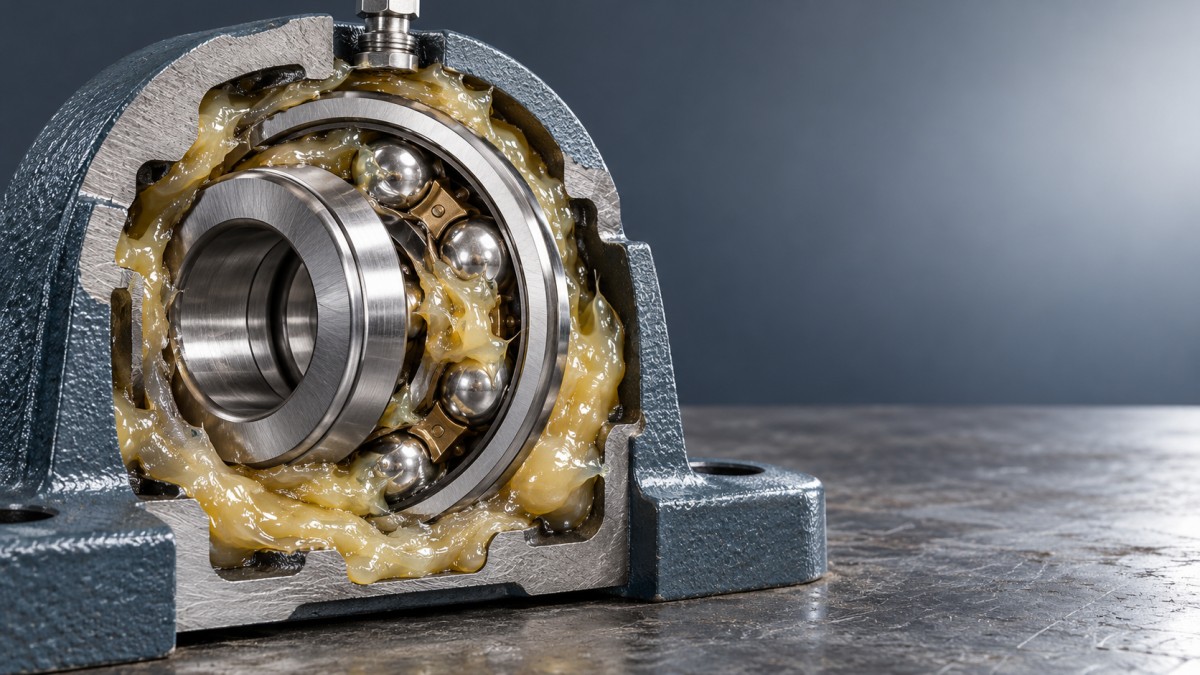
Do not loosen bearing covers, crack seals, or open arbitrary plugs while the equipment is running. If the manufacturer permits a running purge, follow its specific instructions using the designated outlet and required guarding. Never assume that every housing is designed for this method.
Correct the cause—not just the temperature reading
For confirmed overgreasing, use the equipment manufacturer’s method to remove excess lubricant or allow controlled discharge through the intended relief arrangement. Some installations require shutdown and housing access. There is no safe universal instruction to “run it until the extra grease comes out.”
For incompatible or incorrect grease, stop adding material and establish an approved replacement procedure. Depending on accessibility and contamination risk, this may involve disassembly, cleaning, and repacking. Passing a small quantity of new grease through the housing may leave substantial old material behind.
For contamination, address the entry route as well as the lubricant. Check fittings, couplers, storage practices, seals, and washdown exposure. Replacing grease without correcting water or dirt ingress usually produces another service event rather than a lasting repair.
For suspected bearing damage, assess vibration and inspect the bearing when safely accessible. Persistent roughness, abnormal noise, or deteriorating condition after lubrication correction can indicate damage that fresh grease will not repair. Replacement may be necessary, but the original cause must still be identified.
A useful rule is to change one controlled variable at a time where practical. Simultaneously changing lubricant, belt tension, and operating load may reduce the temperature while leaving the actual cause uncertain.
Check whether this bearing should be relubricated at all
Many sealed or shielded deep groove ball bearings are supplied pregreased and intended to operate without routine relubrication. Their presence inside a housing does not automatically mean an external grease fitting delivers lubricant into the bearing’s rolling contact area.
Before establishing a regreasing schedule, confirm the exact bearing designation, closure arrangement, housing design, and machine instructions. Do not remove integral seals simply to introduce grease unless the bearing and equipment procedures specifically allow it.
This distinction matters when sourcing replacements. If reviewing a listing such as 3000, verify the actual bearing type, dimensions, seals or shields, clearance, and lubrication requirements against the application. A product title alone is not enough to confirm interchangeability or maintenance needs.
When discussing a replacement with Shandong Huamai Power Technology Co., Ltd., provide the operating speed, load, temperature history, mounting arrangement, and lubricant details—not only the bearing number. These conditions help establish whether a standard bearing configuration is appropriate or whether the application needs a different specification.
Make the next relubrication event measurable
The most effective prevention is a repeatable lubrication practice that technicians can verify on the shop floor. It should specify the lubricant, quantity, interval, delivery point, and whether the machine must be stopped or may be lubricated while running under an approved procedure.
Manufacturer recommendations should be the starting point. Bearing dimensions, speed, load, temperature, orientation, contamination exposure, and housing free space all influence lubrication needs. A general calculation may provide an initial estimate, but it should not override machine-specific instructions or validated operating experience.
- Measure delivery: calibrate grease-gun output by mass so technicians can translate the specified quantity into a reliable action.
- Identify lubricants clearly: label grease guns, containers, and lubrication points to reduce accidental mixing.
- Keep connections clean: wipe fittings before connection and protect couplers from dirt between uses.
- Record the response: document temperature and condition before servicing and during the subsequent observation period.
- Review repeated heating: recurring spikes suggest that quantity, interval, grease selection, or housing relief needs reassessment.
Longer intervals are not automatically safer, and smaller additions are not automatically sufficient. The objective is an adequate, stable lubricant supply without unnecessary churning or contamination.
When is it reasonable to return to normal operation?
A corrected bearing arrangement should show a stable temperature within the equipment’s approved limits, with no developing abnormal noise or vibration. Compare it with the previous baseline under similar load and ambient conditions, and continue monitoring according to the maintenance procedure.
If the temperature remains elevated despite verified grease quantity, compatibility, and delivery, widen the investigation to fits, operating clearance, alignment, load, and heat from adjacent components. Deep groove ball bearings can tolerate neither lubrication errors nor unsuitable mechanical conditions indefinitely.
The key lesson is straightforward: a hot bearing after regreasing does not necessarily need more grease. It needs a measured diagnosis. Establish the trend, verify what was added and where it went, then make a controlled correction that can be checked against the machine’s actual operating behavior.


Huamai Power
Thank you very much for writing to us. Please leave your message and contact information, we will reply to you within 24 hours.