





News
Contact us and someone will be in touch with you shortly.
Recent News
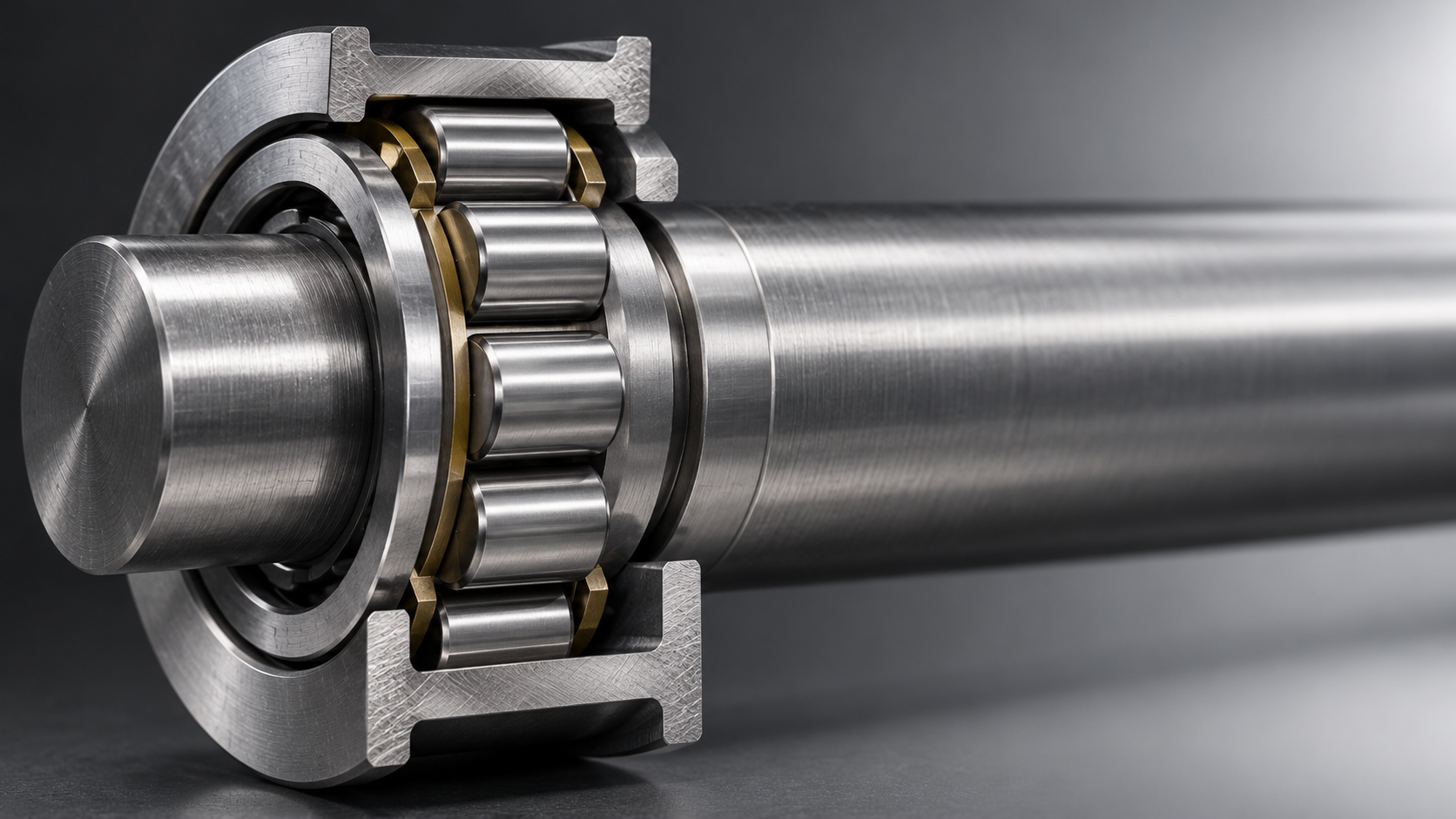
A shaft that runs smoothly during a cold inspection can behave very differently once the machine reaches operating temperature. As the shaft expands relative to its housing, the bearing arrangement must accommodate that movement without creating unintended axial forces. This is where the configuration of cylindrical roller bearings becomes as important as their load rating.
Use an NU configuration when the bearing must carry radial load while allowing axial displacement in both directions within the bearing itself. It is typically selected for the non-locating position in an arrangement where another bearing locates the shaft axially. Industrial motors, gearboxes and other rotating equipment often benefit from this separation of responsibilities.
However, “the shaft needs room to expand” is only the starting point. A sound selection also considers external thrust, displacement limits, misalignment, lubrication and assembly access.
What an NU bearing actually does—and what it does not
A standard single-row NU cylindrical roller bearing has two integral flanges on the outer ring and no flanges on the inner ring. The outer-ring flanges guide the roller set, while the flangeless inner raceway permits relative axial movement between the rings in either direction, within the bearing’s specified displacement limits.
This makes the NU design a radial support with internal axial freedom. It does not locate the shaft axially and should not be assigned an external thrust-carrying function in its standard configuration.
That distinction prevents a common selection error: confusing axial movement capability with axial load capacity. An NU bearing allows movement; it does not provide the axial restraint needed to control shaft position. Gear mesh forces, coupling reactions or process thrust must be handled elsewhere in the arrangement.
Its separable construction also helps during assembly. The inner ring and the outer ring with the roller-and-cage assembly can be mounted separately. Where interference fits are required, this can simplify installation without transmitting mounting force through the rolling contacts.
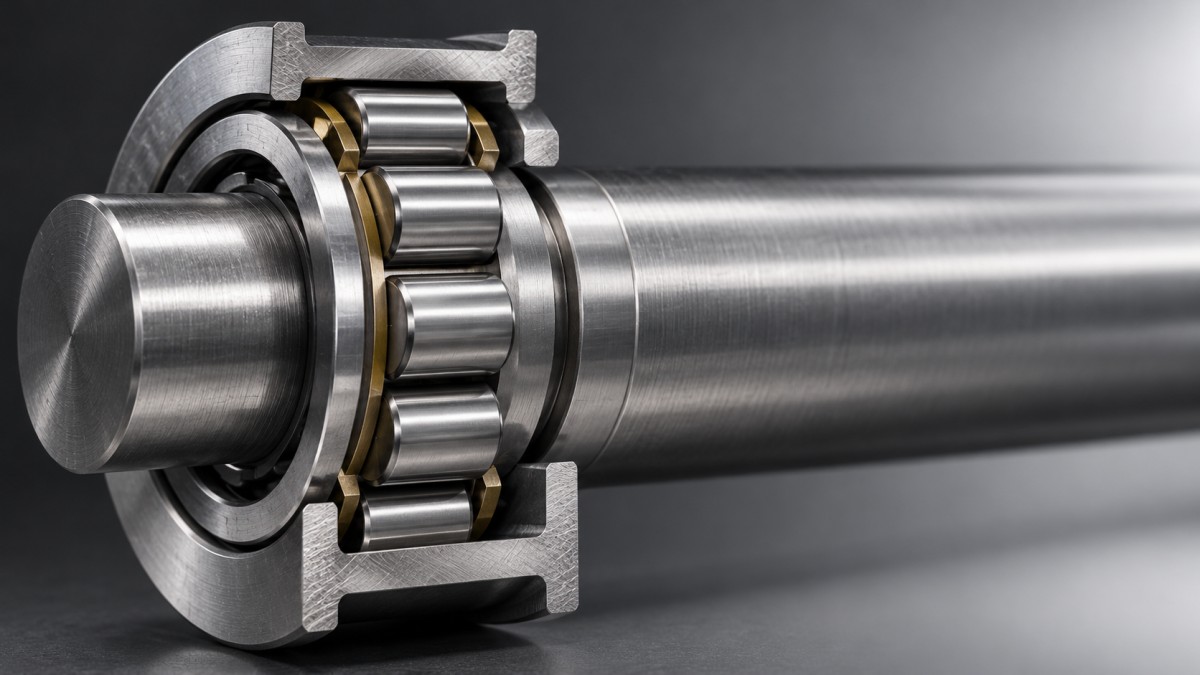
NU, N, NJ or NUP: choose according to the shaft-location task
These configurations share cylindrical rolling elements, but their flange arrangements give them different axial functions. Selecting by bore size and dynamic load rating alone can therefore produce a bearing that fits the shaft but does not suit the machine.
NU is not inherently a better floating bearing than N. Both can provide internal axial freedom. The practical choice depends on mounting sequence, which ring should retain the roller assembly, adjacent components and the availability of the required bearing design.
NJ and NUP designs need a different evaluation. Their flanges can transmit axial forces, but permissible thrust depends on roller-end/flange contact conditions, lubrication, speed and heat generation. They should not be treated as unrestricted combined-load alternatives to angular contact ball bearings or tapered roller bearings.
When NU cylindrical roller bearings make the strongest case
The locating bearing is already defined
An NU bearing is a logical candidate when another bearing or bearing set controls axial position. For example, a locating support may carry radial load and bidirectional thrust, while the NU support carries its share of the radial load and accommodates differential thermal expansion.
The important question is not simply whether two bearings support the shaft. It is whether their axial responsibilities are explicitly assigned. If both supports unintentionally locate the shaft, thermal growth can generate internal forces that were absent from the original external-load calculation.
The application combines substantial radial load with thermal growth
Cylindrical roller bearings offer high radial load capacity and radial stiffness within a suitable installation envelope. An NU configuration preserves these characteristics while avoiding the need for a ring to slide in its housing seat to accommodate shaft expansion.
This is useful where load direction, vibration or operating conditions call for secure fits on both rings. Internal axial displacement can allow those fits to be selected for their seating function rather than relying on a loose ring fit as the expansion mechanism.
Axial sliding at the housing seat would be unreliable
A floating support based on a ring sliding in the housing can work well when correctly designed. However, corrosion, contamination, seat damage or an unsuitable fit can obstruct movement. An NU bearing moves the intended displacement into the bearing geometry.
That does not make movement limitless or frictionless. Available raceway travel, roller contact conditions and the installed ring positions still matter. The advantage is a defined internal displacement mechanism, not permission to ignore tolerances.
Calculate the movement before choosing the bearing
A useful first estimate of free thermal expansion is:
ΔL = α × L × ΔT
Here, α is the material’s linear expansion coefficient, L is the relevant length from the locating reference to the non-locating support, and ΔT is the temperature rise. For bearing selection, the decisive quantity is the relative movement between shaft and housing, not shaft growth considered in isolation.
For illustration, a steel shaft with a relevant length of 1,000 mm and a temperature rise of 50°C expands approximately 0.6 mm when an expansion coefficient of 12 × 10−6/°C is used. This is only a preliminary estimate: housing expansion, temperature gradients and the actual location of the axial reference can change the required bearing displacement.
Check the resulting movement against the selected bearing manufacturer’s permissible axial displacement. Include:
- Assembly tolerances and the initial axial position of the rings.
- Movement during start-up, steady operation and shutdown.
- Possible displacement in either direction, including abnormal temperature conditions.
- Clearance to shoulders, seals, covers and adjacent rotating components.
A bearing may have sufficient total travel yet still run out of available movement in one direction if assembled too close to an end position. The cold assembly position should therefore follow the calculated operating movement rather than an automatic assumption of perfect centering.
Conditions that can rule out an NU configuration
Unresolved thrust is the clearest warning. A helical gearbox may have an attractive radial load profile for cylindrical rollers, but its axial gear force still needs a defined load path. If no other support carries that force, an NU bearing alone is not a complete solution.
Significant misalignment is another concern. Cylindrical roller bearings have limited tolerance for angular misalignment; shaft deflection, housing-bore errors and mounting inaccuracies can produce unfavorable load distribution. Roller profiling can reduce edge stress within design limits, but it does not turn an NU bearing into a self-aligning bearing.
Where substantial radial loading is combined with unavoidable misalignment, a spherical roller bearing may warrant evaluation instead. A product such as 23984 MB/W33 belongs in that alternative-bearing discussion, not as an NU configuration substitute. Its suitability must be checked against the application’s load, speed, fit and axial-displacement arrangement.
NU also deserves caution under very light radial load at high speed. Rolling elements require sufficient load to maintain appropriate rolling conditions; inadequate loading can promote sliding and smearing. Use the supplier’s minimum-load guidance rather than assuming that a large capacity margin always improves reliability.
Details that decide whether the arrangement works in service
Internal clearance must be evaluated after mounting and heating
Interference fits and differences in ring temperature alter radial internal clearance. Too little operating clearance can increase heat and contact stress; excessive clearance can reduce load distribution quality and affect vibration.
Do not select a larger clearance class merely because the machine runs warm. Evaluate shaft and housing fits, material properties, ring temperatures, speed and the required operating clearance together. Axial freedom in an NU design does not compensate for an unsuitable radial-clearance choice.
Lubrication must match the actual duty
Speed capability depends on the complete bearing design, cage, lubricant viscosity, lubricant delivery and heat removal. The NU designation alone does not establish a permissible operating speed.
For grease lubrication, consider grease quantity, relubrication access and the risk of churning losses. For oil lubrication, verify that the contact zone receives adequate oil without excessive drag. In either case, contamination control is essential, particularly in mining, metallurgy and agricultural equipment where abrasive particles can compromise raceways and roller surfaces.
Mounting should preserve both accuracy and travel
Separable construction makes installation more manageable, but it does not remove the need for controlled mounting. Apply fitting force to the ring being mounted, protect the raceways and roller set, and avoid cocking the rings during assembly.
Ring retention should secure the components on their seats without obstructing the intended relative axial movement inside the bearing. Check shoulder dimensions, corner radii and surrounding clearances against the bearing drawing. Do not interchange components from different bearings unless the manufacturer explicitly permits it.
A practical approval checklist for technical evaluators
Before approving an NU cylindrical roller bearing, the selection record should answer six questions:
- Where is the shaft located axially? Identify the bearing or bearing set responsible for thrust and shaft position.
- What radial duty must the NU bearing carry? Include normal operation, peak loading, shocks and minimum-load conditions.
- How much relative axial movement is required? Compare the complete displacement envelope with the specific bearing’s allowable travel.
- Are alignment and stiffness acceptable? Review shaft deflection, housing accuracy and support deformation.
- Will fits and temperatures produce suitable operating clearance? Evaluate the mounted, running condition rather than catalog clearance alone.
- Can the bearing be lubricated, assembled and inspected properly? Confirm these requirements before releasing the arrangement.
For a manufacturer such as Shandong Huamai Power Technology Co., Ltd., a useful selection discussion starts with these operating inputs rather than a bearing designation alone. Shaft and housing drawings, load cases, speed range, temperatures, lubrication method and expected displacement provide the basis for evaluating a standard NU bearing or whether a customized design needs consideration.
Choose NU when radial support and axial freedom belong at the same bearing position, while axial location belongs elsewhere. If the application instead requires that position to carry thrust, tolerate substantial misalignment or provide more travel than the bearing permits, reconsider the arrangement—not just the bearing size.


Huamai Power
Thank you very much for writing to us. Please leave your message and contact information, we will reply to you within 24 hours.